If you’ve posted a cloud or DevOps role in the last year and felt buried under applications within hours, you’re not imagining it. Hiring didn’t get easier when AI entered the picture — for a lot of teams, it got noisier.
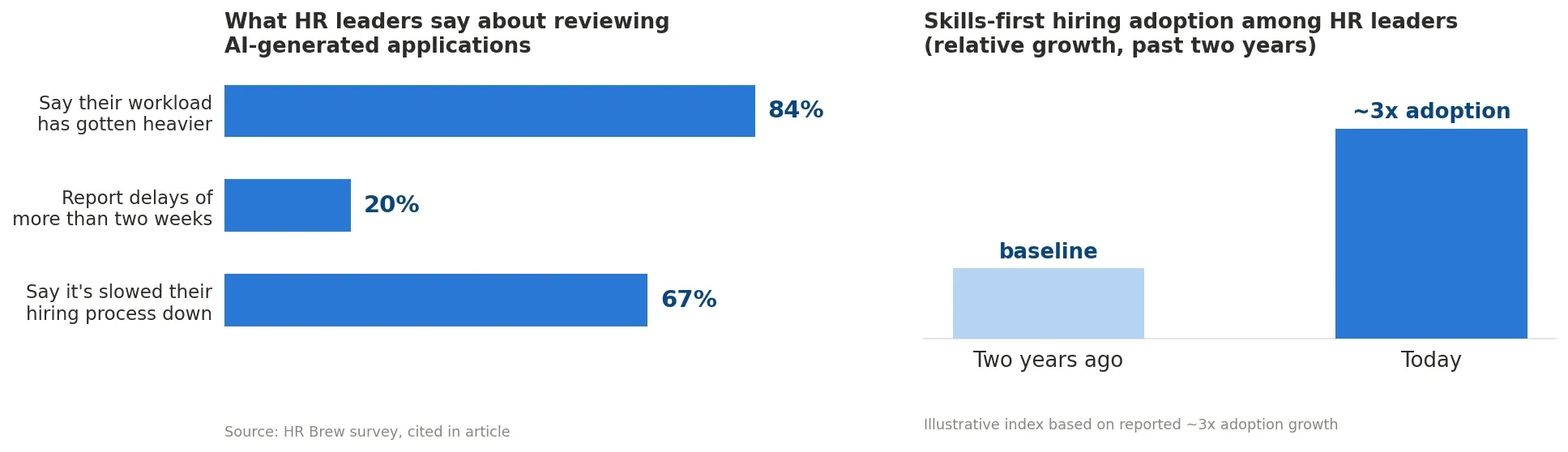
LinkedIn now sees roughly 11,000 applications submitted every minute on the platform, a 45% jump in a single year. The average job opening draws around 242 applications. And according to a recent HR Brew survey, 67% of HR leaders say reviewing AI-generated applications has actually slowed their hiring process down, one in five report delays of more than two weeks, and 84% say their workload has gotten heavier, not lighter.
That’s the part of the “AI is transforming hiring” story that doesn’t get talked about enough: AI made it radically easier for candidates to apply everywhere, instantly, with polished résumés generated in seconds. It did not make it easier for companies to figure out who’s actually right for the role. More access to candidates was supposed to mean better hires. For a lot of teams, it’s meant the opposite, a bigger haystack, with the same needle still missing.
What’s actually changing: hiring is becoming skills-first, not resume-first
The companies handling this well aren’t the ones getting more applications. They’re the ones that got more specific before they opened the funnel. Skills-first hiring — evaluating people on verified certifications, hands-on experience, and demonstrated work rather than job titles or degrees — has roughly tripled in adoption among HR leaders over the past two years, and that shift is accelerating fastest in technical hiring, where the cost of a bad match is highest.
In practice, that means asking a different set of questions before you post a role:
- Do we need someone who’s built this exact thing before, or someone who can learn it fast?
- Is “AWS experience” on a résumé worth anything without a certification or a verifiable project behind it?
- Are we hiring for a fixed-scope project, an ongoing team gap, or a long-term build — because that changes what “the right fit” even looks like?
- Would we rather see fewer, pre-matched candidates, or more candidates we have to screen ourselves?
- Most companies still default to the last option — cast a wide net and sort it out later. That’s exactly the habit that’s getting more expensive as AI makes the net infinitely easy to widen.
Where NerdRabbit fits
This is the problem NerdRabbit was built around: not getting companies more candidates, but getting them the right ones, with the filtering already done.
The matching runs on skills, certifications, experience, location, and rate — not keyword overlap — so the candidates you see have already been scored against what the role actually requires. Profiles are anonymized on the front end, which means the first thing you evaluate is what someone has actually done, not a name, a school, or a photo.

Depending on what you’re solving for, that matching plugs into two different models. NerdRabbit Select is for when you need a team, not just a hire: a hand-selected pod of specialists assembled for a specific project or migration. NerdRabbit Direct is closer to traditional recruitment, backed by certified recruiters, for when you’re filling a single role the old-fashioned way but want the sourcing and vetting done right. Neither is about sending you more résumés. Both are about sending you fewer, better-matched ones — drawn from a pool of 1,000+ AWS-certified professionals across cloud, DevOps, security, data, and AI/ML.
What NerdRabbit isn’t: another place to post a job and watch applications pile up. If what you need is volume, the AI application flood has already solved that problem for you, for better or worse.
The takeaway
The AI application flood isn’t going away, and more applicants per role isn’t a trend you can opt out of. But it does change what’s worth optimizing for: not how many candidates you can reach, but how precisely you can define what you need and how quickly you can get in front of people who actually match it.
If you’re not sure which model fits your situation, a project team, a single hire, a skills gap you haven’t fully defined yet, talk to NerdRabbit and we’ll help you figure out what “the right match” should actually look like before you post the role.